Should I max my 457(b) or save for a house down payment?
The Problem
There are really three questions tangled together here: is the house fund actually done, how much 457(b) can the monthly cash flow support, and does any of the HYSA belong in a brokerage account? A projection can answer all three at once, so let's model it.
The Solution
I modeled this in HoneyPlan straight from the numbers in the question:
- Income: $42,000/year net, which is $3,500/month of take-home pay.
- Expenses: $1,000/month of living costs, exactly as described.
- Cash: $65,000 total ($5,000 checking floor at 0%, the remaining $60,000 in a 4% HYSA).
- Roth IRA: $20,000 at 7% expected return (I combined the $19,000 Roth and the $1,000 rollover Roth, since they behave identically here).
- The 457(b): starts at $0 with the full $1,958/month contribution ($23,500/year, the 2026 limit).
- The condo: a one-time $40,000 down payment and closing costs in July 2027, followed by $1,050/month of new housing costs (mortgage, HOA, taxes) on a modest LCOL condo.
The projection below has three toggle pills on the banner, and this is where it gets useful:
- Max the 457(b): toggles the full $1,958/month contribution on and off. Off means the money stacks as cash instead.
- Buy the Condo: toggles the down payment and the new monthly housing costs together.
- Trips & Surprises: adds the $250/month the asker admitted they weren't counting. Click it and watch how little it changes the answer.
The Projection
Ten years, with the 457(b) maxed and the condo purchased on schedule:
The Results
| Stacking cash | Maxing the 457(b) | |
|---|---|---|
| Monthly surplus while rent-free | +$2,500 | +$542 |
| Cash at closing (Jul 2027) | ~$98,000 | ~$74,000 |
| Cash after the down payment | ~$61,000 | ~$35,000 |
| Monthly net after the condo | +$1,450 | -$508 |
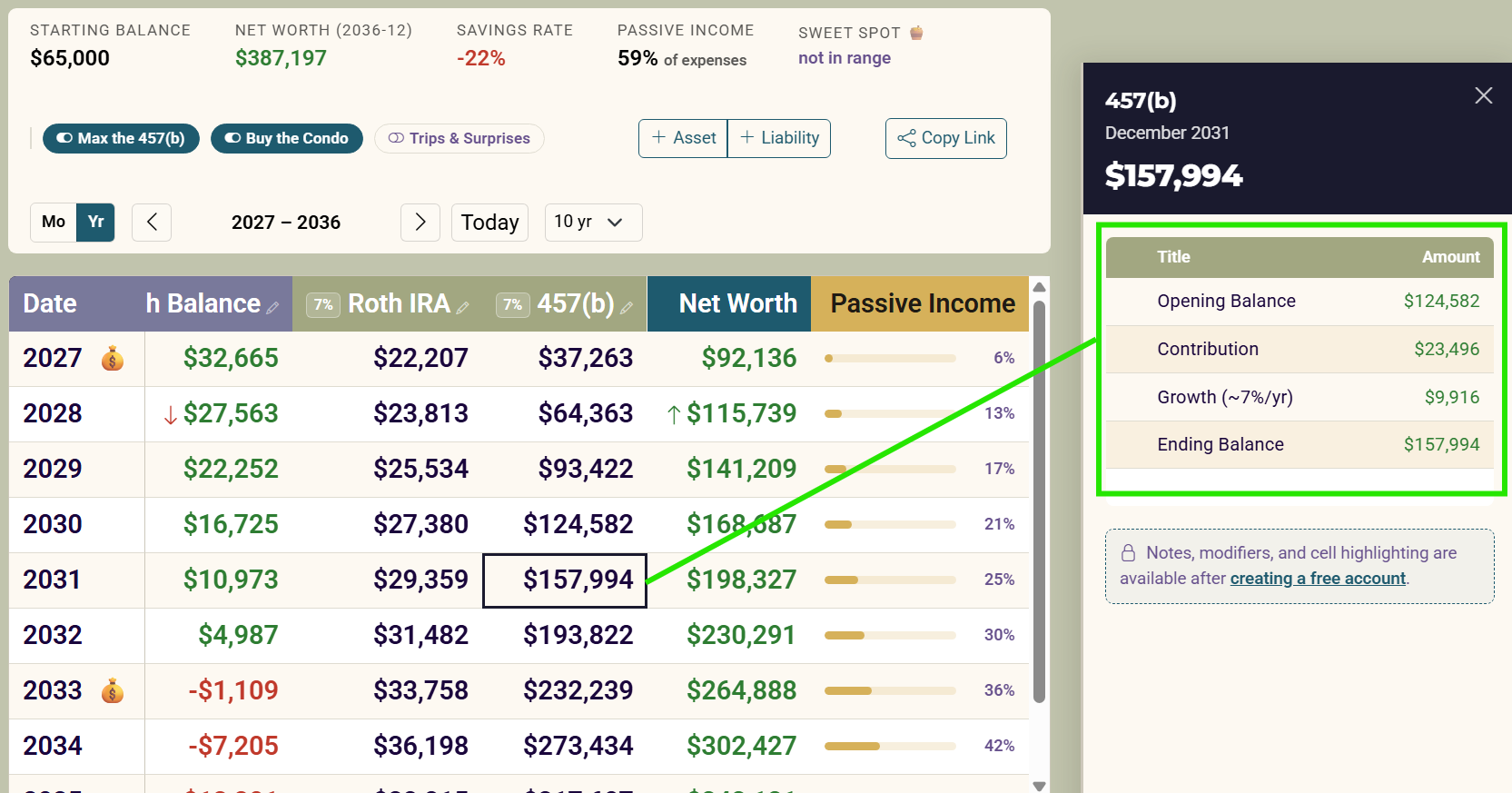
| 457(b) balance at pension vesting (Jun 2031) | $0 | ~$141,000 |
| Net worth in 2036 | ~$312,000 | ~$365,000 |
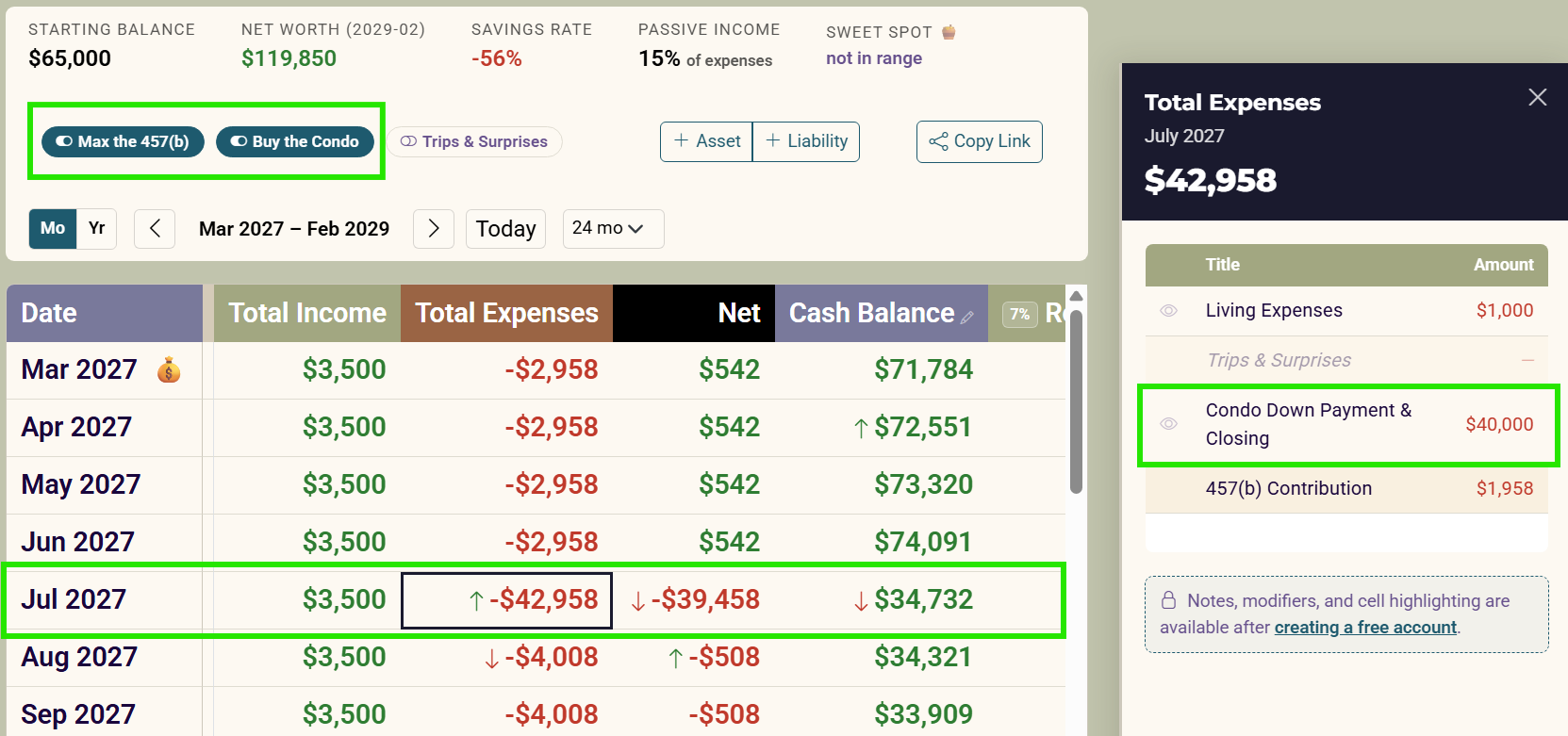
First insight: the house fund is already done. The $60,000 HYSA covers the $40,000 down payment plus a six-month emergency fund ($6,000 at these expenses) with roughly $14,000 to spare. Every additional dollar routed to cash "for the house" is solving a problem that no longer exists. That's what makes this a false choice: with $2,500/month of surplus and the down payment fully funded, maxing the 457(b) costs the house purchase nothing. Toggle the Max the 457(b) and check the Cash Balance column: even maxing the whole year, the plan arrives at closing with >$74,000 and leaves with >$34,000 still in the bank.
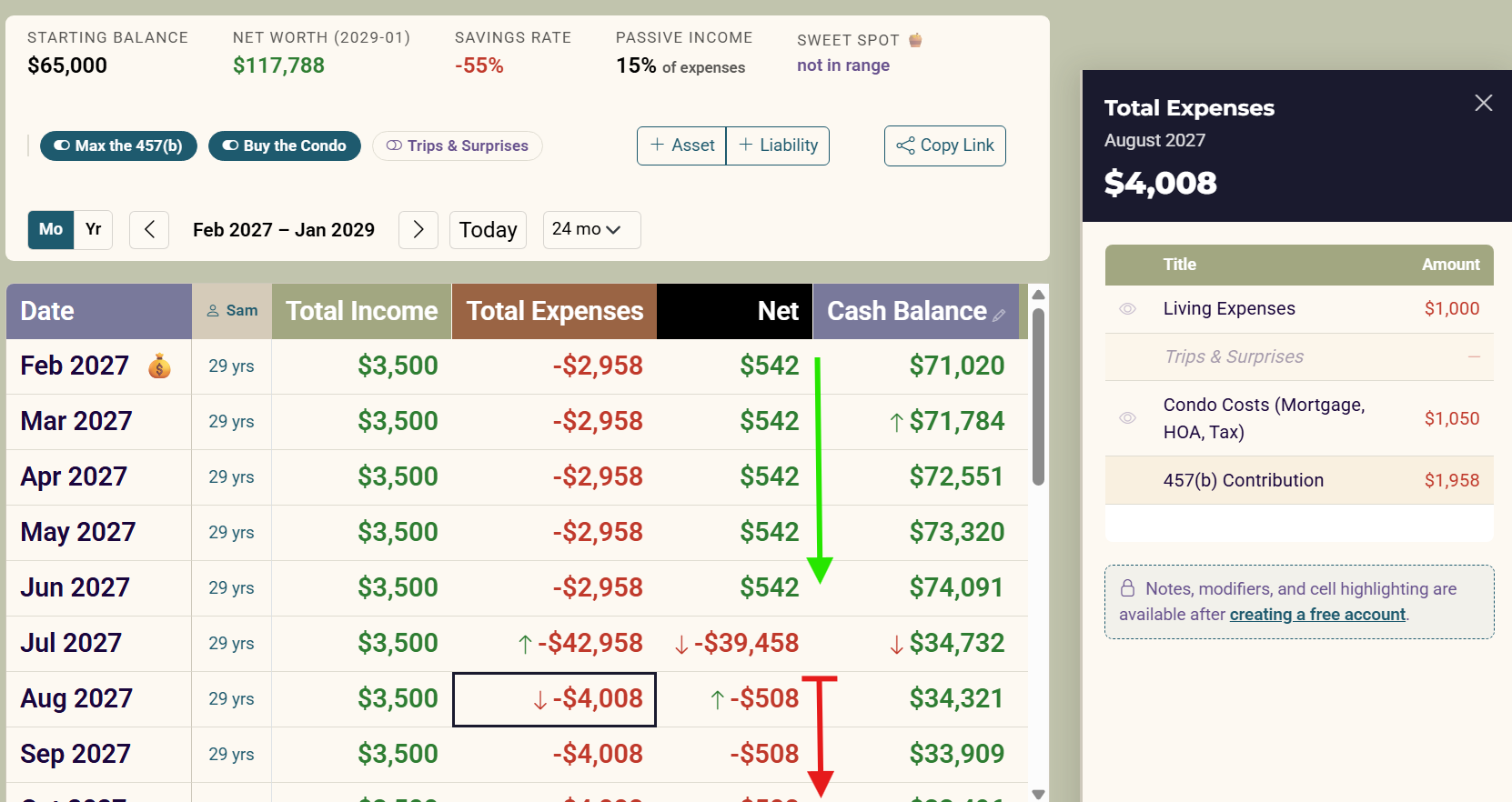
Second insight: the max is only free while the housing is free. Look at the Net column after July 2027. Once the condo adds $1,050/month, the full contribution pushes monthly net to roughly -$508. The cash cushion absorbs that for years, but it's a slow leak, not a plan: keep scrolling and the grid shows cash crossing below zero in late 2033 if the contribution never comes down. The sustainable contribution after closing is about $1,450/month, which is still $17,400/year into the 457(b). So the answer has a shape: front-load hard during the rent-free year, then dial back to what the new budget supports.
Third insight: the brokerage idea has a timeline problem. Money earmarked for a purchase 12 months away doesn't belong in stocks; a normal market dip at the wrong moment turns the down payment into a forced loss. The HYSA is already doing its job. After the condo closes and the emergency fund is rebuilt, a taxable brokerage becomes the right home for surplus beyond the 457(b), not before.
Two things this model leaves out, and both favor the 457(b) even more. The income here is modeled as net, but 457(b) contributions are pre-tax: take-home falls by less than the $1,958 that goes in, so the real monthly squeeze is smaller than the grid shows. And a 457(b) has a feature nothing else in this plan has: withdrawals are penalty-free after separation from the employer at any age, which makes it arguably the best early-retirement account that exists.
The Conclusion
Max it now, dial it back later. Grab any employer match first (that's free money at any timeline), then run the full $1,958/month while housing costs are zero. Buy the condo out of the HYSA exactly as planned, keep six months of the new, higher expenses as the emergency floor, and drop the contribution to roughly $1,450/month once the mortgage starts. Leave the house money in the HYSA until closing day, and let the brokerage wait its turn.
"I feel behind" was the emotional center of this question, and it's the part the projection answers best: on these numbers the plan reaches ~$365,000 in net worth by 2036, about $53,000 ahead of the stacking-cash path, with a vested pension on top of all of it. Ther user isn't behind. The numbers just hadn't been laid out where they could be seen.
Open this exact plan in the full demo, put in your own numbers, and toggle the scenarios yourself. Runs in your browser, no account, no email.
Open This Plan in the Demo