Should I pay off credit card debt or build an emergency fund first?
The Problem
This is the classic tension: the card charges 22% while the savings account pays 4%, so mathematically every spare dollar "should" go to the card. But the emergency fund isn't competing on yield. It's the thing that keeps the next surprise from going right back onto the card. So let's model all three options and, more importantly, let's model the surprise.
The Solution
I modeled this in HoneyPlan straight from the numbers in the question:
- Income: $3,400/month take-home (the 4% 401k match contribution is already out of this number, and it stays: a 100% match beats even a 22% card).
- Fixed expenses: $1,300 rent and utilities plus $900 of other fixed costs, $2,200/month total.
- The card: $8,000 at 22% APR, modeled at a $600/month payment (the middle ground), with an alternate all-in version at $1,200/month.
- Cash: the $3,000 starter emergency fund, earning 4% in a HYSA.
- The stress test: a one-time $2,000 car repair six months in, because the whole point of an emergency fund is months you didn't plan.
The projection below has two Scenario toggle pills on the banner:
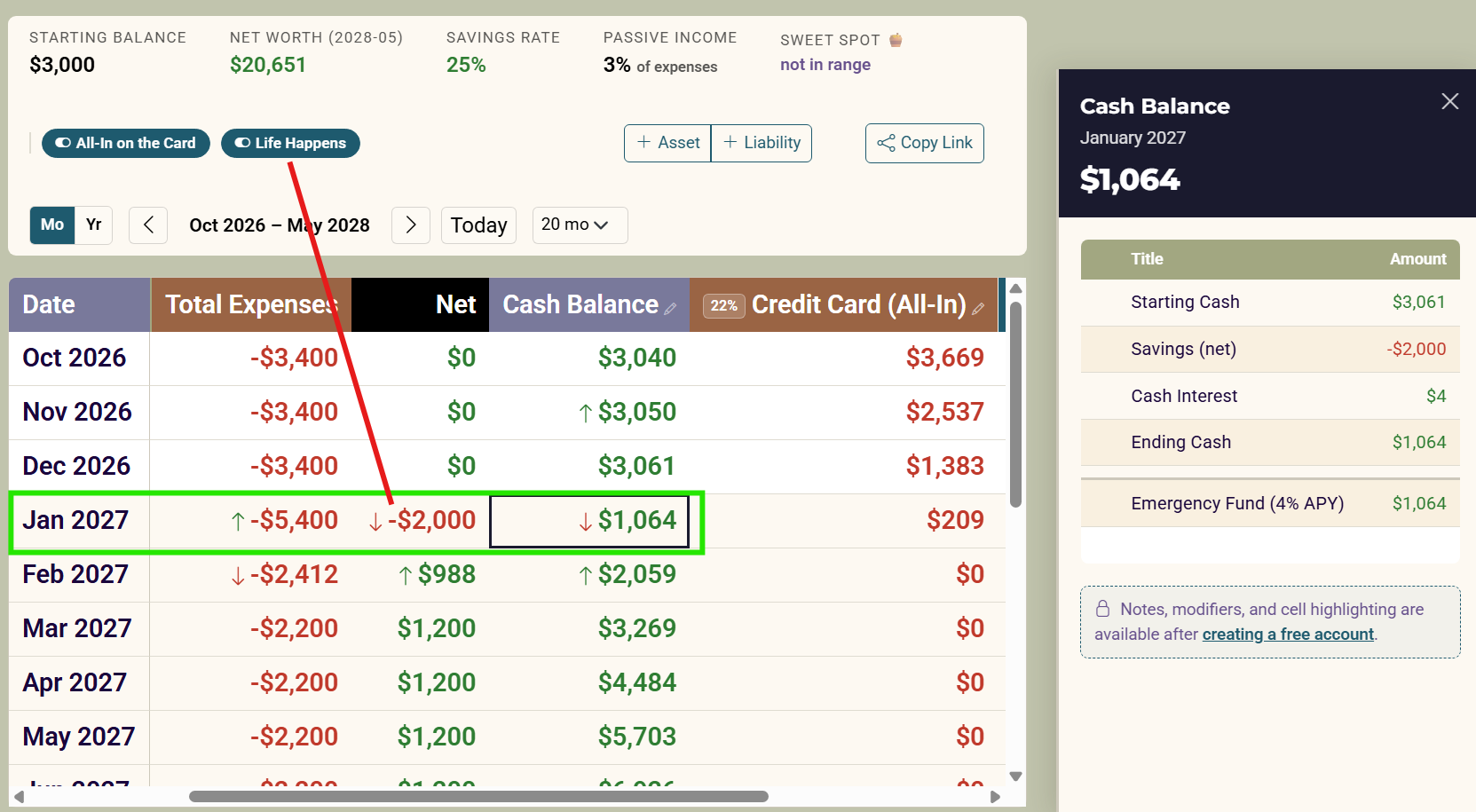
- All-In on the Card: swaps the $600/month payment for $1,200/month, every spare dollar to the card. Off means the middle ground: $600 to the card, ~$400 banked.
- Life Happens: drops the $2,000 repair into January 2027. Try it with each strategy and watch what the emergency fund is actually for.
The Projection
Twenty months, on the middle-ground plan:
The Results
| Minimums only ($200) | All-in ($1,200) | Middle ground ($600) | |
|---|---|---|---|
| Card paid off | 6 years (73 months) | Feb 2027 (8 months) | Oct 2027 (16 months) |
| Total interest paid | ~$6,551 | ~$612 | ~$1,259 |
| Emergency fund during payoff | grows, slowly bleeding interest | pinned at $3,000 | grows every month |
| Cash banked at payoff | - | ~$4,100 | ~$13,400 (6 months of expenses) |
First insight: the middle ground does both jobs at once. At $600/month the card dies in October 2027, 16 months in, for $1,259 of total interest. Meanwhile the leftover ~$400/month builds the emergency fund the entire time: it never dips, and on the very month the card hits zero the plan is holding $13,383, right at six months of expenses. The asker's "starter fund, then debt, then rebuild" sequence turns out to be unnecessary: with this cash flow there's no "then". Both finish lines get crossed the same month.
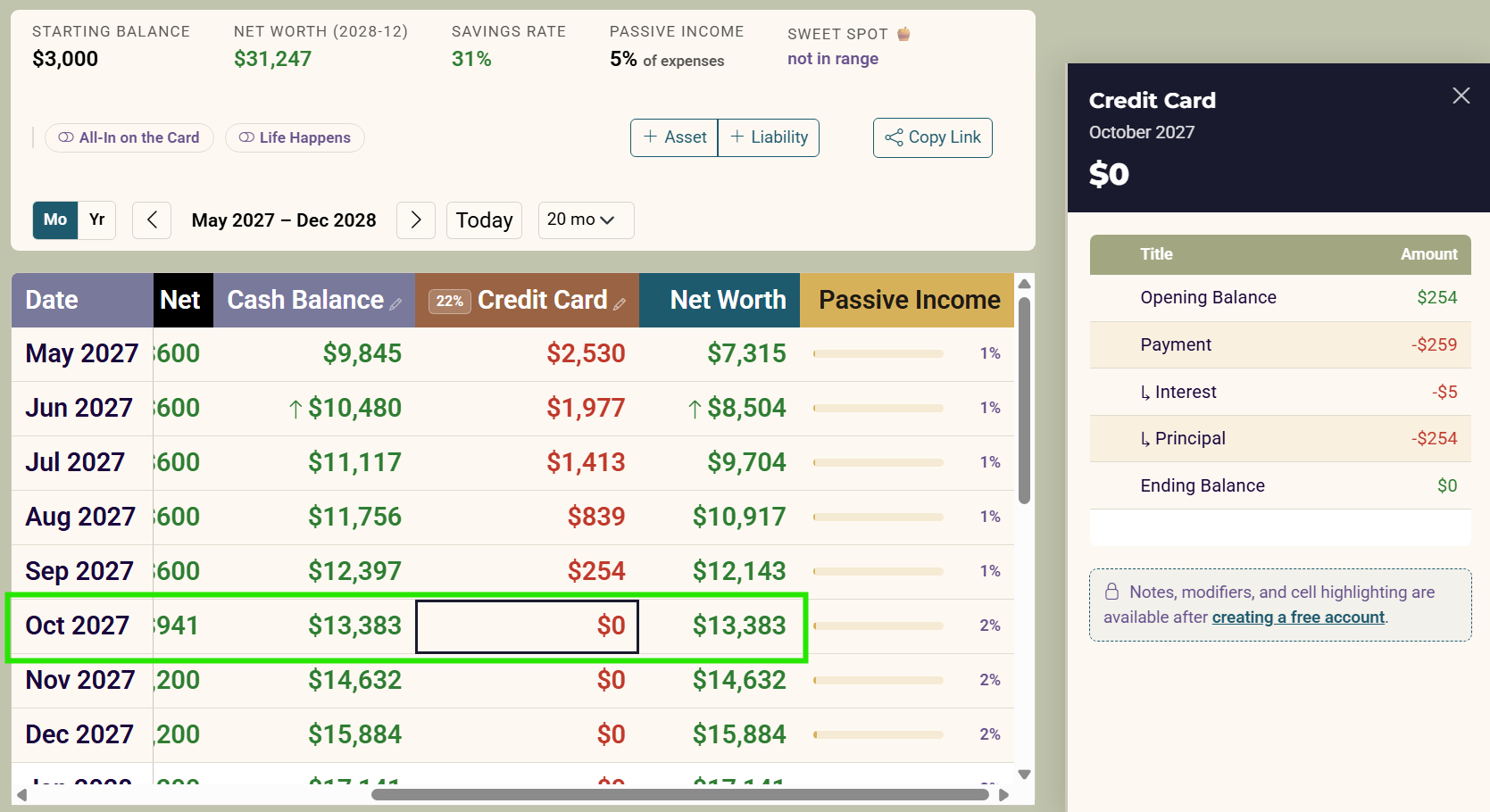
Second insight: going all-in saves $647 and charges you certainty for it. The $1,200/month attack kills the card in February 2027 and pays only $612 of interest, $647 less than the middle ground. That's the entire prize. The price is eight months with the emergency fund pinned at $3,000. Now click Life Happens with All-In still on: the January repair drags cash down to $1,064, less than two weeks of expenses. One more surprise in that window and it goes straight onto a 22% card, resurrecting the exact debt being killed. Spread over eight months, that $647 works out to about $81/month, which is cheap insurance against restarting the whole cycle.
Third insight: net worth tells the encouraging version of this story. The plan starts at roughly -$4,000 net worth ($3,000 cash minus $8,000 of card debt). On the middle ground, every month moves that number about $1,000 in the right direction: $600 of dead debt plus $400 of new savings. The Net Worth column crosses zero in November 2026, five months in. Back to broke by Thanksgiving, and it only gets better from there. For contrast, the minimums-only path (not a pill, but easy to check with our minimum payment calculator) takes 73 months and $6,551 of interest, nearly re-buying the original debt.
The Conclusion
Take the middle ground: $600 to the card, $400 to the fund. The all-or-nothing framing is a false choice at this cash flow. Splitting the $1,000 surplus clears the card in 16 months, never leaves the emergency fund exposed, and arrives at payoff day with six months of expenses banked. The extra $647 of interest versus going all-in is the premium on an insurance policy this plan genuinely needs, because a $3,000 cushion and a 22% card is a bad place to meet a surprise.
And the part most answers skip: have a plan for the $600 the day the card dies. Redirect it straight into a Roth IRA before it dissolves into lifestyle. At 7%, $600/month is roughly $77,000 by age 32. The same discipline that killed the card becomes the thing that makes "behind" impossible.
Open this exact plan in the full demo, put in your own numbers, and toggle the scenarios yourself. Runs in your browser, no account, no email.
Open This Plan in the Demo